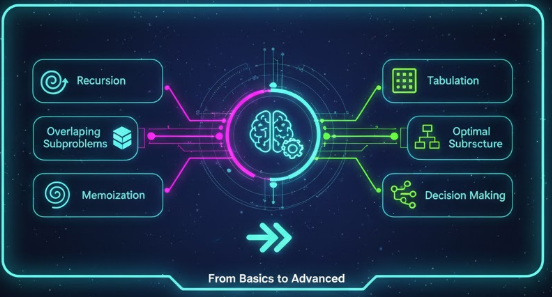
Dynamic Programming (DP) transforms exponential-time problems into polynomial-time solutions by avoiding redundant calculations through memoization or tabulation.
What is Dynamic Programming?
DP is applicable when:
- Optimal Substructure: Optimal solution can be constructed from optimal solutions of subproblems
- Overlapping Subproblems: Same subproblems are solved multiple times
Memoization vs Tabulation
Memoization (Top-Down)
// Fibonacci with Memoization
int memo[100];
memset(memo, -1, sizeof(memo));

int fib(int n) {
    if (n <= 1) return n;
    if (memo[n] != -1) return memo[n];
    return memo[n] = fib(n-1) + fib(n-2);
}
Tabulation (Bottom-Up)
// Fibonacci with Tabulation
int fib(int n) {
    int dp[n+1];
    dp[0] = 0; dp[1] = 1;
    for (int i = 2; i <= n; i++)
        dp[i] = dp[i-1] + dp[i-2];
    return dp[n];
}
Classic DP Problems
1. Longest Common Subsequence
int lcs(string a, string b) {
    int n = a.size(), m = b.size();
    int dp[n+1][m+1];

    for (int i = 0; i <= n; i++) {
        for (int j = 0; j <= m; j++) {
            if (i == 0 || j == 0) dp[i][j] = 0;
            else if (a[i-1] == b[j-1])
                dp[i][j] = dp[i-1][j-1] + 1;
            else
                dp[i][j] = max(dp[i-1][j], dp[i][j-1]);
        }
    }
    return dp[n][m];
}
2. 0/1 Knapsack
int knapsack(int W, vector& wt, vector& val, int n) {
    int dp[n+1][W+1];

    for (int i = 0; i <= n; i++) {
        for (int w = 0; w <= W; w++) {
            if (i == 0 || w == 0) dp[i][w] = 0;
            else if (wt[i-1] <= w)
                dp[i][w] = max(val[i-1] + dp[i-1][w-wt[i-1]], dp[i-1][w]);
            else
                dp[i][w] = dp[i-1][w];
        }
    }
    return dp[n][W];
}
Problem-Solving Strategy
- Define the state clearly
- Identify the base cases
- Write the recurrence relation
- Determine the order of computation
- Optimize space if needed